Human factors for the work India actually does
KĀRYA – Applied Human Factors and Ergonomics Laboratory
Nearly 9 in 10
workers in India are informally employed — most with no employer* to redesign the job, the tool or the workplace.
— inferred from ILO and India Employment Report 2024
*The ‘no employer’ clause is the author’s inference from the report's data on self-employment and casual work, not a direct statement from the report
Our premise
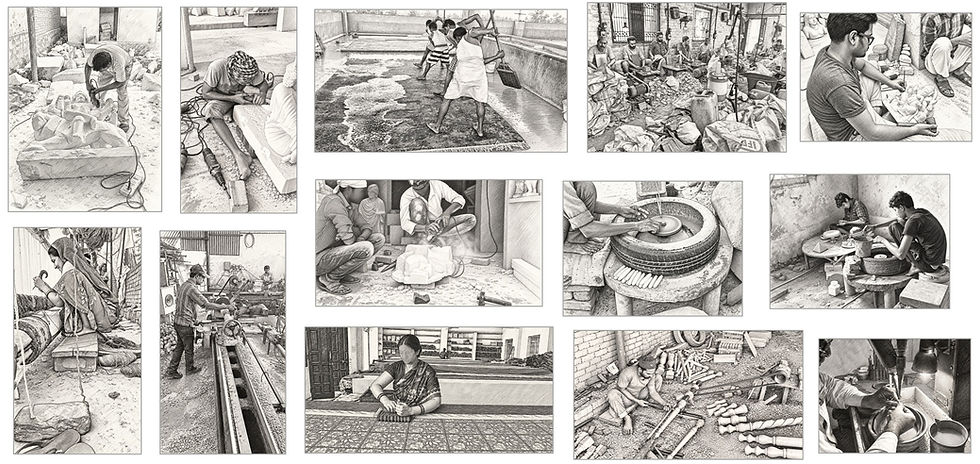
Mainstream ergonomics assumes an employer who controls the workplace, buys the tools and answers to a regulator. Most Indian work has none of these. An artisan buys their own tools; a delivery rider owns the vehicle; for a home-based worker, the workstation is the floor.
So KĀRYA builds evidence and designs that reach the worker directly — through the tool, the garment, the workstation and the know-how they carry.
What “KĀRYA” means
KĀRYA (Sanskrit: कार्य) literally means work, action, purpose, task – core concepts in ergonomics, which studies the ‘interaction between people and the work they perform’.
We study how work affects the people who do it, and design ways to make it healthier, safer and more productive. Our focus is the work India depends on but rarely protects: on occupational health of workers/users in informal sector, wider workforce in small and medium enterprises (SMEs), where formal occupational health protection rarely reaches.
Measure in the field, validate in the lab, co-design with workers
01
Measure in the field
We study work where it happens — measuring physical, cognitive and environmental stressors (posture, force, workload, time pressure, information overload, noise, vibration, heat, dust, illumination) in workshops, clusters and on the road.
02
Validate in the lab
We recreate critical tasks under controlled conditions to understand why harm occurs and to test design ideas rigorously
03
Co-design low-cost solutions
We design tools, equipment and workstations with users — affordable, repairable and locally made — and test them back in the field until they work, and keep being used.
Research Tracks
We build evidence about the worker and turn it into design solutions that reach the informal workforce directly.
TRACK A
The Working Body
Biomechanics and musculoskeletal risk mapping of manual labor, focusing on floor-seated, repetitive woodworking and artisanal weaving.
TRACK C
The Working Mind
Studying human error, cognitive fatigue, and craft mastery to design interfaces that strengthen rather than erode skill.
TRACK B
The Working Environment
Building evidence on occupational heat strain, dust exposure, and combined environmental stressors for unprotected informal workers.
TRACK D
Design for Work
Co-designing affordable, repairable tools and workstations with workers — including passive exoskeletons and usable PPE.
RECENT RECOGNITION
Dr Ashish Kumar Singh receives the Outstanding Engineering Services to Society Award from The Institution of Engineers (India), 2026.
Latest news
Oct 2026
Abhishek Das begins a student research exchange at the Technical University of Munich (TUM).
Sep 2026
“Ergonomic design and evaluation of woodworking chisel” accepted in WORK.
Sep 2026
Dr Ashish Kumar Singh receives the Outstanding Engineering Services to Society Award from The Institution of Engineers (India).
Apr 2026
“Ergonomic evaluation and design of carpet hand loom” accepted in Ergonomics in Design.
Feb 2026
KĀRYA is established at the Department of Design, IIT Kanpur.
Get in touch
We welcome researchers, students, and collaborators who want to bridge the gap between human factors theory and the reality of work in India.
Principal Investigator
Dr Ashish Kumar Singh
Assistant Professor,
Department of Design
Location
Room 601H-I, DJAC Building
IIT Kanpur, Kanpur 208016
Uttar Pradesh, India
Contact
✉ ashish@iitk.ac.in
☎ +91 512 679 2648